- On sale!
- -50%
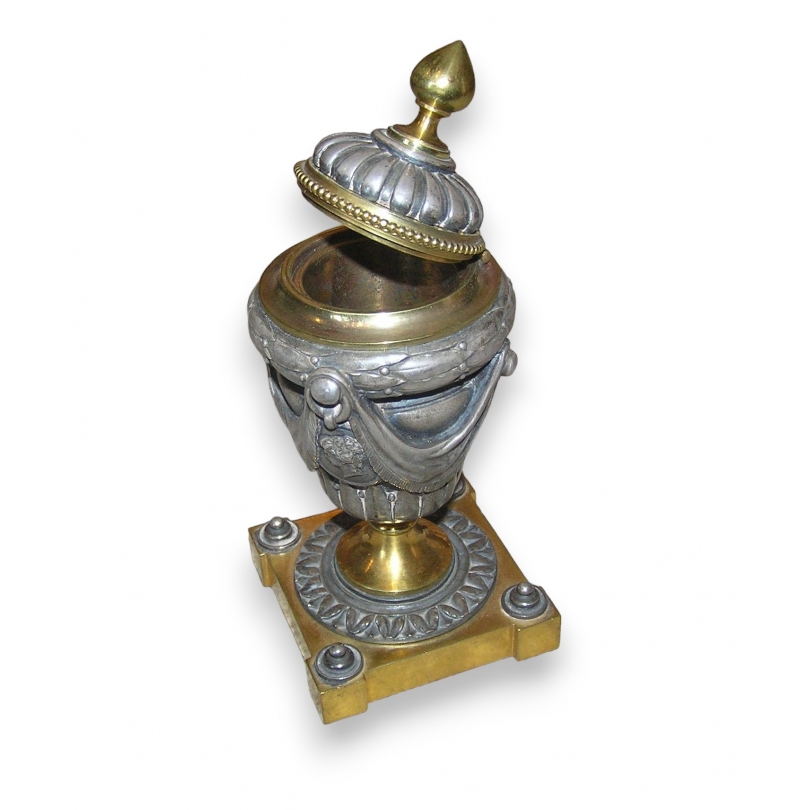

Fire pot, France, gilded and silver-plated bronze, marked ‘L.OUDRY cie frères édit
’. In 1854, Léopold Oudry founded his electrochemical workshop in the village of Auteuil (annexed to Paris in 1860), at 10 Rue Cuissard (now Rue Félicien David). By 1855, Oudry was already renowned for his cast-iron vases and statuettes coated with pure copper applied by electroplating, a process for which the Parisian silversmith Charles Christofle had purchased the patents as early as 1839. Jean-Charles Alphand, Director of Public Roads and Promenades in Paris under Napoleon III, immediately recognised the potential of this system for the beautification and preservation of monumental fountains and public street lamps. Oudry was thus awarded the contract for the electroplating of all cast-iron objects and monuments in the city of Paris. As the workshop on Rue Cuissard was no longer suitable, Oudry established a large electrochemical factory at 10 bis Route de Versailles, employing an average of 150 workers. Taking part in the famous World’s Fairs, Léopold Oudry won a second-class medal in Paris in 1855. In 1861, he achieved a remarkable feat: the copper-plating of the two monumental fountains on the Place de la Concorde, erected by Hittorff in 1838 and which had previously had to be repainted every year. At the 1862 London World’s Fair, Oudry exhibited decorative objects, such as vases, candelabra and statuettes in bronze or iron, which had been copper-plated or bronzed using the same technique. In the 1880s, the foundry was bought by Antoine Durenne, the iron-casting specialist from Sommevoire.
Bibliography
: ‘La petite sculpture au XIXe s. Les éditeurs’, Bernard Metman, Archives de l’Art français, 1989, vol. XXX.
Origin: France
Period: 19th century
Materials: Gilded bronze
Dimensions: H 17 x 7 cm
Data sheet
Fire pot, France, gilded and silver-plated bronze, marked ‘L.OUDRY cie frères édit
’. In 1854, Léopold Oudry founded his electrochemical workshop in the village of Auteuil (annexed to Paris in 1860), at 10 Rue Cuissard (now Rue Félicien David). By 1855, Oudry was already renowned for his cast-iron vases and statuettes coated with pure copper applied by electroplating, a process for which the Parisian silversmith Charles Christofle had purchased the patents as early as 1839. Jean-Charles Alphand, Director of Public Roads and Promenades in Paris under Napoleon III, immediately recognised the potential of this system for the beautification and preservation of monumental fountains and public street lamps. Oudry was thus awarded the contract for the electroplating of all cast-iron objects and monuments in the city of Paris. As the workshop on Rue Cuissard was no longer suitable, Oudry established a large electrochemical factory at 10 bis Route de Versailles, employing an average of 150 workers. Taking part in the famous World’s Fairs, Léopold Oudry won a second-class medal in Paris in 1855. In 1861, he achieved a remarkable feat: the copper-plating of the two monumental fountains on the Place de la Concorde, erected by Hittorff in 1838 and which had previously had to be repainted every year. At the 1862 London World’s Fair, Oudry exhibited decorative objects, such as vases, candelabra and statuettes in bronze or iron, which had been copper-plated or bronzed using the same technique. In the 1880s, the foundry was bought by Antoine Durenne, the iron-casting specialist from Sommevoire.
Bibliography
: ‘La petite sculpture au XIXe s. Les éditeurs’, Bernard Metman, Archives de l’Art français, 1989, vol. XXX.
Origin: France
Period: 19th century
Materials: Gilded bronze
Dimensions: H 17 x 7 cm