- On sale!
- -50%
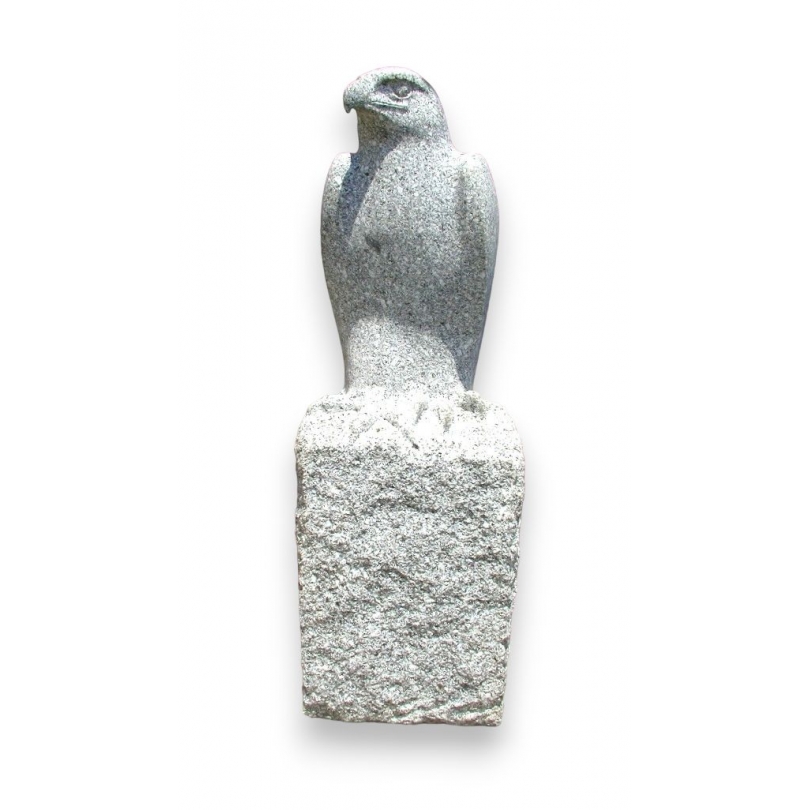


Cubist sculpture ‘Rapace or Eagle’, by Georges HILBERT, Paris, a friend of SANDOZ. Provenance: ‘Le Manoir St-Prex’, Oscar Forel collection.
Georges HILBERT (1900–1982)
Georges Hilbert was born in 1900 in Nemours (Djemaa el Ghazaouet), Algeria. The son of a veterinary surgeon, he enrolled at the École des Beaux-Arts in Oran in 1918. However, he studied there very little, as in the same year he moved to Paris, where he continued his artistic training at the School of Decorative Arts and the School of Fine Arts. Yet it was chiefly at the Jardin des Plantes, observing the animals, that he learnt his craft. There he produced numerous drawings and occasionally carved sketches in soft stone. He then went on to create works carved directly from blocks of limestone, granite or marble. ‘Through unique forms, observed and contemplated at length, it is the very essence of the stag, or that of the panther, that he manages to capture. ’ (Dubois, Patrice, ‘Hilbert, the sculptor of living things’, Revue des Artistes Français, 1983). Two animal sculptors profoundly inspired his vision: he draws inspiration from the direct carving technique of the Spanish artist Mateo Hernandez (1885–1949) and observes the elegant proportions, the clarity of form and the serene expression in the works of François Pompon (1865–1933).
From 1925, he was a member of the Salon d’Automne. From 1926, he exhibited at the Salon des Tuileries and, the following year, at the Salon des Indépendants. In 1928, he was awarded the Blumenthal Prize, which opened the doors to private collections and museums in the United States, and enabled him to undertake a trip to Egypt in 1930, where he rediscovered the great tradition of animal art in the temples of Luxor, Karnak and the quarries of Aswan. In 1973, he was awarded the Edouard-Marcel Sandoz Prize for his entire body of work.
His numerous awards, acquisitions by museums and collectors, and private and state commissions enabled him to create large-scale works: the Pergola de la Douce France in Étampes (1924), the bas-reliefs for the new bird of prey enclosure at the Jardin des Plantes (1935), the baptismal font at the Cathedral of the Grand Duchy of Luxembourg (1937), the four life-size lions at the Château de la Trousse (1951) and twelve bas-reliefs for the villa of the Governor of the Bank of Algeria in Algiers (1951).
Origin: France
Period: 20th century
Materials: Granite
Dimensions: H 103 x 36 x 34 cm
Data sheet
Cubist sculpture ‘Rapace or Eagle’, by Georges HILBERT, Paris, a friend of SANDOZ. Provenance: ‘Le Manoir St-Prex’, Oscar Forel collection.
Georges HILBERT (1900–1982)
Georges Hilbert was born in 1900 in Nemours (Djemaa el Ghazaouet), Algeria. The son of a veterinary surgeon, he enrolled at the École des Beaux-Arts in Oran in 1918. However, he studied there very little, as in the same year he moved to Paris, where he continued his artistic training at the School of Decorative Arts and the School of Fine Arts. Yet it was chiefly at the Jardin des Plantes, observing the animals, that he learnt his craft. There he produced numerous drawings and occasionally carved sketches in soft stone. He then went on to create works carved directly from blocks of limestone, granite or marble. ‘Through unique forms, observed and contemplated at length, it is the very essence of the stag, or that of the panther, that he manages to capture. ’ (Dubois, Patrice, ‘Hilbert, the sculptor of living things’, Revue des Artistes Français, 1983). Two animal sculptors profoundly inspired his vision: he draws inspiration from the direct carving technique of the Spanish artist Mateo Hernandez (1885–1949) and observes the elegant proportions, the clarity of form and the serene expression in the works of François Pompon (1865–1933).
From 1925, he was a member of the Salon d’Automne. From 1926, he exhibited at the Salon des Tuileries and, the following year, at the Salon des Indépendants. In 1928, he was awarded the Blumenthal Prize, which opened the doors to private collections and museums in the United States, and enabled him to undertake a trip to Egypt in 1930, where he rediscovered the great tradition of animal art in the temples of Luxor, Karnak and the quarries of Aswan. In 1973, he was awarded the Edouard-Marcel Sandoz Prize for his entire body of work.
His numerous awards, acquisitions by museums and collectors, and private and state commissions enabled him to create large-scale works: the Pergola de la Douce France in Étampes (1924), the bas-reliefs for the new bird of prey enclosure at the Jardin des Plantes (1935), the baptismal font at the Cathedral of the Grand Duchy of Luxembourg (1937), the four life-size lions at the Château de la Trousse (1951) and twelve bas-reliefs for the villa of the Governor of the Bank of Algeria in Algiers (1951).
Origin: France
Period: 20th century
Materials: Granite
Dimensions: H 103 x 36 x 34 cm